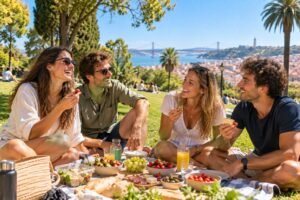
Portugal does not celebrate three times a year, it celebrates all year round. Festivals in Portugal fill the calendar from January to December, from the February Carnival to the grilled sardines of June, from village romarias in August to the consoada dinner on 24 December. For anyone who has just moved, that is a huge advantage: these events are free or nearly free, they happen outdoors in the street, and nobody asks you for a membership card. Here is the full calendar, the 13 official public holidays with their 2026 and 2027 dates, what actually closes, the etiquette you need and the real cost of a night out.
Why Portuguese festivals make arriving easier
When you land in a city you do not know, the hard part is not finding activities. It is finding situations where talking to strangers is normal. A neighbourhood arraial is exactly that. Tables are long and shared, you sit wherever there is space, and the person next to you pours you wine before asking your name. Nobody wonders how long you have lived there.
The second reason is practical. These parties are run by neighbourhood associations called coletividades, and they always need hands to build the stalls, run the bar and sew the costumes for the marchas. Showing up in June and offering to help, even with forty words of Portuguese, is the fastest way to go from tourist to neighbour. Many newcomers say their first real friendships started there rather than in an expat bar. Our guide to making friends in Lisbon covers the other routes.
The third reason is the language. At an arraial you do not need to hold a conversation. You need ten sentences: order, thank, say where you are from, ask what something is. It is low stakes practice, very different from an evening class.
The festival calendar month by month
These are the dates that really matter, the ones Portuguese people cross the country for. Fixed dates are shown, the others move each year. For detailed programmes and confirmed dates, the national tourist board publishes everything on visitportugal.com.
| Month | Festival | City or region | What happens |
|---|---|---|---|
| January | Dia de Reis and cantar as janeiras | Nationwide | Groups singing door to door, shared bolo-rei cake on 6 January |
| February | Carnival, 17 February 2026 and 9 February 2027 | Torres Vedras, Ovar, Loulé, Podence | Satirical floats, parades, Caretos masks listed by UNESCO |
| March or April | Holy Week | Braga above all | Night processions, the whole city decorated, the most famous in Portugal |
| April | Dia da Liberdade, 25 April | Lisbon | Parade on Avenida da Liberdade, red carnations, free concerts |
| May | Queima das Fitas | Coimbra | Student week, night serenata, black capes and coloured ribbons |
| May | Festa das Cruzes | Barcelos | Flower carpets in the streets, brass bands, fireworks |
| June | Festas de Lisboa and Santo António, 12 and 13 June | Lisbon: Alfama, Graça, Mouraria, Bica | Marchas populares, grilled sardines, street parties all night |
| June | São João, night of 23 to 24 | Porto | Plastic hammers, glowing balloons, fireworks over the Douro |
| June | São Pedro, 29 June | Póvoa de Varzim, Sintra, Montijo | Rusgas, neighbourhood parades, dancing until sunrise |
| July | Festa dos Tabuleiros, expected July 2027 | Tomar | Procession of bread and flower trays carried on the head |
| August | Romaria da Senhora da Agonia, around 20 August | Viana do Castelo | Regional costumes, family gold, flower carpets, boat procession |
| August | Village festivals and arraiais | Everywhere, mostly in the North | Barbecues, dancing under paper garlands, free entry, family feel |
| September | Festa da Nossa Senhora dos Remédios, 6 to 8 September | Lamego | Procession up a baroque stairway of more than 600 steps |
| September | Feira de São Mateus | Viseu | One of the oldest fairs in the country, concerts and food stalls |
| October | Harvest festivals and autumn fairs | Douro valley, Vila Franca de Xira | New wine, markets, Ribatejo bull running traditions |
| November | São Martinho and magusto, 11 November | Nationwide | Roast chestnuts, jeropiga wine, small fires lit in the street |
| December | Consoada on the 24th, Natal on the 25th | Everywhere | Boiled salt cod, rabanadas, bolo-rei, presents opened at midnight |
| December | Passagem de ano, 31 December | Lisbon, Terreiro do Paço, and Funchal | Twelve raisins at midnight, free concerts, fireworks |
June, the month of the Santos Populares
If you only remember one month, remember June. Lisbon changes completely for four weeks and the peak falls on the night of 12 to 13 June for Santo António. On the evening of the 12th the marchas populares come down Avenida da Liberdade: every neighbourhood presents its choreography, its costumes sewn over months and its song. Grandstand seats are paid, the rest of the city is free.
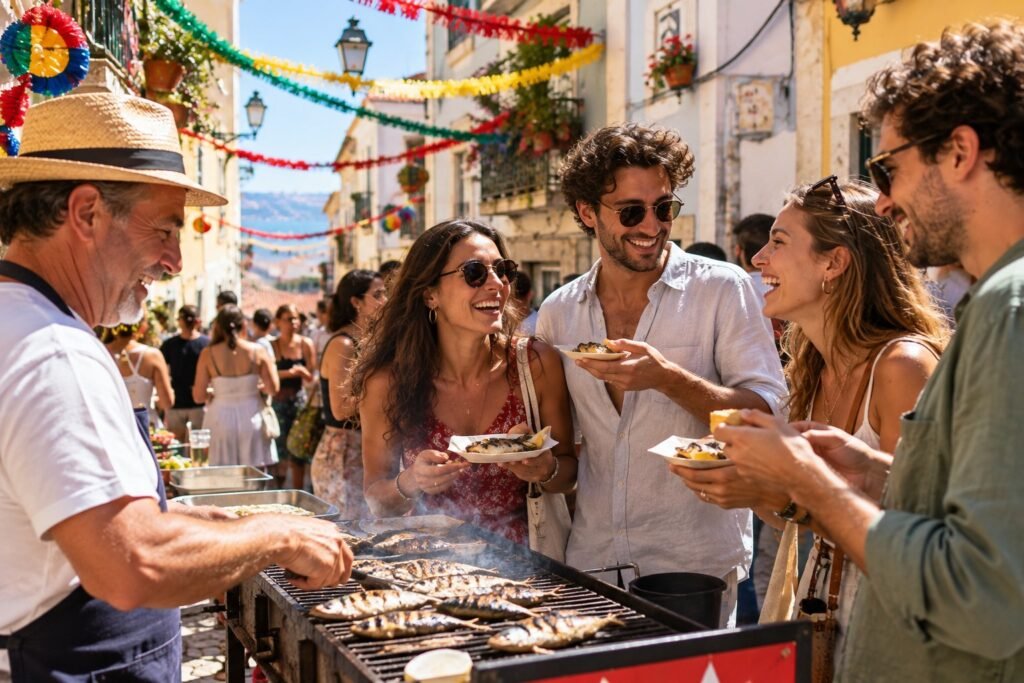
After the marcha the party moves into the lanes of Alfama, Graça, Mouraria, Bica and Madragoa. Grills appear outside every door, sardine smoke drifts everywhere, speakers play pimba music and people dance between the facades until dawn. The traditional gift is a pot of basil, the manjerico, with a small paper poem stuck in it, because Santo António is the saint of lovers and lost objects. The 13th is a public holiday in Lisbon only, the feriado municipal. Our guide to living in Lisbon sets out how the city works the rest of the year.
In Porto the night of 23 to 24 June belongs to São João, and it is even stranger the first time: everyone taps everyone else on the head with plastic hammers, or with a garlic flower for the historic version. Thousands of glowing balloons rise into the sky, barbecues take over Fontainhas and Ribeira, fireworks burst over the Douro around midnight, and part of the city then walks to the sea at Foz to watch the sunrise. The 24th is a public holiday in Porto.
Summer romarias, Lamego in September, magusto in November
From July to September the celebrations leave the big cities for the villages. Every parish has its romaria: mass in the morning, a procession in the afternoon, grilled food and a dance at night, often three days in a row. Entry is free and you only pay for what you eat and drink. It is the best way to see the Portugal guidebooks skip, and a train ticket or a shared ride is enough.
Two events stand out. The Romaria da Senhora da Agonia in Viana do Castelo, around 20 August, brings out regional costumes and inherited gold necklaces, with flower carpets painted on the ground overnight. And the Festa da Nossa Senhora dos Remédios in Lamego, from 6 to 8 September, revolves around a monumental baroque stairway of more than 600 steps that the whole procession climbs, some pilgrims on their knees, while brass bands play below.
On 11 November the country switches to magusto for Saint Martin: roast chestnuts, a glass of jeropiga or água-pé, small fires lit in courtyards and sometimes in the street. It is a festival of colleagues and neighbours rather than family, so it is very easy to join when you have just arrived. If your company organises something around the 11th, say yes.
December: consoada, Christmas and New Year
Christmas in Portugal happens on the evening of the 24th, not at lunch on the 25th. That meal is the consoada: boiled salt cod served with potatoes, cabbage and a lot of olive oil, known as bacalhau cozido com todos. Then come the desserts, and there are many: rabanadas, sonhos, filhós, aletria and the bolo-rei crowned with candied fruit. Presents are opened at midnight, often after mass. If a colleague invites you to their consoada, accept. A Portuguese family will not let anyone spend the 24th alone.
On 31 December people eat twelve raisins at midnight, one per chime, each one a wish for the matching month. Lisbon sets up a stage and fireworks at Terreiro do Paço, and access is free. Funchal on Madeira fires one of the largest firework displays in Europe over its bay. Then on 6 January, Dia de Reis closes the season with the janeiras, groups who sing door to door and leave with a drink and a slice of bolo-rei.
The 13 public holidays in 2026 and 2027
Portugal has 13 national public holidays. Four move every year because they depend on Easter, which falls on 5 April in 2026 and 28 March in 2027. One point matters for your leave planning: a holiday falling on a Saturday or a Sunday is not moved to the Monday. In 2027, five of the thirteen land on a weekend.
| Public holiday | Date in 2026 | Date in 2027 | Day of the week in 2027 |
|---|---|---|---|
| Ano Novo, New Year | 1 January | 1 January | Friday |
| Sexta-feira Santa, Good Friday | 3 April | 26 March | Friday |
| Páscoa, Easter Sunday | 5 April | 28 March | Sunday |
| Dia da Liberdade, Carnation Revolution | 25 April | 25 April | Sunday |
| Dia do Trabalhador, Labour Day | 1 May | 1 May | Saturday |
| Corpo de Deus, Corpus Christi | 4 June | 27 May | Thursday |
| Dia de Portugal | 10 June | 10 June | Thursday |
| Assunção de Nossa Senhora | 15 August | 15 August | Sunday |
| Implantação da República | 5 October | 5 October | Tuesday |
| Todos os Santos, All Saints | 1 November | 1 November | Monday |
| Restauração da Independência | 1 December | 1 December | Wednesday |
| Imaculada Conceição | 8 December | 8 December | Wednesday |
| Natal, Christmas Day | 25 December | 25 December | Saturday |
Two clarifications. Carnival, widely celebrated, is not one of the thirteen: it is a tolerance day each employer grants or not, sometimes as a half day. And every municipality adds its own feriado municipal, which only applies locally: 13 June in Lisbon, 24 June in Porto. These days come on top of the 22 working days of statutory annual leave, explained in our article on paid leave in Portugal.
What closes, local etiquette and tipping
A Portuguese public holiday does not empty the city. Banks, public offices, schools and doctors close. Large shopping centres stay open on most holidays, often with shorter hours, and so do many supermarkets. Small corner shops pull the shutters down. Cafés and restaurants work, because it is usually their best day. Public transport runs on a Sunday timetable, so services are less frequent, and a duty pharmacy, the farmácia de serviço, stays open in each area with its address posted in the windows of the others.
There are two real exceptions: on 25 December and 1 January almost everything is closed, including many restaurants, and on 24 December everything shuts in the early afternoon. Do your shopping the day before.
A few habits are enough on the etiquette side. If someone invites you home, bring something: a bottle of vinho verde, pastéis de nata, beer, anything but empty hands. For a private party, arrive fifteen to twenty minutes after the stated time, because nobody is ready before. At a restaurant, be on time. Lunch runs from 12.30 to 14.30, dinner from 20.00 to 22.30, and a neighbourhood arraial only really starts around 22.00 and ends at daybreak.
The couvert, the bread, olives and cheese placed on your table without being ordered, is charged. You can politely decline it or simply not touch it, and it will be taken back and left off the bill. Tipping is not compulsory and never included: round up the bill, leave one euro per person in a tasca, 5 to 10 per cent in a good restaurant. Finally, you look people in the eye when you clink glasses, and you do not serve yourself first.
What a festival night actually costs
Here is the good surprise: a night of Santo António costs about the same as a fast food meal back home. Arraiais are free to enter, you only pay for what you consume, and the stalls are run by neighbourhood associations, so prices stay close to cost. Here is a realistic budget for a full evening in Alfama, using indicative prices from recent editions.
| Item | What you get | Indicative price |
|---|---|---|
| Transport | Metro or bus, there and back | around 3.60 euros |
| Grilled sardines | Two sardines on a slice of bread | around 6 euros |
| Bifana or caldo verde | One portion | around 3 euros |
| Beer | Three imperiais | around 5 euros |
| Ginjinha | One glass of sour cherry liqueur | around 1.50 euros |
| Manjerico | One basil pot to take home | around 3 euros |
| Total for the evening | All six items | around 22 euros |
With a metropolitan Navegante pass at 40 euros a month, the transport line disappears from the table. The rest of the year the scale stays gentle: a coffee at the counter costs 0.80 to 1 euro, a full prato do dia at lunch 8 to 12 euros. Taking part in Portuguese social life does not require a big budget, only leaving the flat.
Living these festivals from the inside means being there all year, not four days in June. That is what our customer advisor roles in Lisbon and Porto allow, working for major international brands. We recruit French, German and Dutch speakers for their native language, English is used internally. The package is a renewable 12 month contract, paid initial training, a salary of around 1,060 euros gross per month paid 14 times a year, and above all accommodation provided for the whole length of the contract, with rent, bills and internet covered. The flight is refunded or paid depending on your market, and the partner company handles the NIF and NISS paperwork, health cover and the airport pickup. You need to be an EU citizen, a native speaker of one of those three languages, have decent English for internal use and at least a secondary school diploma. Have a look at our jobs in Portugal, and check your rights as an EU citizen on the official EURES portal, the European employment network.
FAQ
Are shops open on public holidays in Portugal?
Mostly yes. Large shopping centres and many supermarkets open on public holidays, often with shorter hours. Banks, public offices and small corner shops close. Cafés and restaurants stay open. The only real exceptions are 25 December and 1 January, when almost everything is shut, plus the afternoon of 24 December.
Do I need to speak Portuguese to go to an arraial?
No. At a neighbourhood arraial you order, you say thank you and you dance, which is plenty for a first time. A few words do change how you are welcomed, so learn at least bom dia, obrigado or obrigada, uma imperial se faz favor and a conta se faz favor. In Lisbon and Porto many young people speak English and will happily help.
How many public holidays fall on a weekend in 2027?
Five out of thirteen: Easter Sunday on 28 March, Dia da Liberdade on Sunday 25 April, Labour Day on Saturday 1 May, Assunção on Sunday 15 August and Christmas Day on Saturday 25 December. Portugal does not move them to the following Monday. On the other hand 2027 offers three useful long weekends, on Friday 1 January, Friday 26 March and Thursday 10 June.